

Knowledge Transfer Partnerships (KTPs)
Connect your organisation with world-class academic expertise in medicines manufacturing. KTPs are funded, structured collaborations that embed research capability directly into your business — driving innovation, building skills and delivering competitive advantage.
Technology Readiness Levels 3-5
What is a KTP?
Funded collaboration between industry and academia
Knowledge Transfer Partnerships (KTPs) are a UK-wide programme that connect businesses with academic knowledge. Through CMAC, your organisation gains direct access to expertise in continuous manufacturing, digital process design, crystallisation, and advanced CMC — embedded in a project tailored to your specific challenge.
-
Access cutting-edge research
Embed CMAC's expertise in mechanistic modelling, digital twins and continuous manufacturing directly in your development workflows.
-
Build talent in-house
A high-calibre KTP Associate — typically a postgraduate researcher works within your team, transferring knowledge and upskilling your staff throughout the project.
-
Accelerate innovation
Structured to bridge TRL 3–5, KTPs move technology from proof of concept into validated, industry-ready processes, faster than traditional R&D routes.
-
Co-funded by Innovate UK
Grant funding covers a substantial portion of project costs, making KTPs an accessible route to applied research for SMEs and large organisations alike.
Four steps to a KTP
-
Contact our industry team to discuss your challenge. We'll explore whether a KTP is the right mechanism and identify the most relevant academic expertise within CMAC.
-
Together we define a clear innovation challenge, TRL targets, and expected outcomes. The project must align with CMAC's research focus in medicines manufacturing and CMC.
-
We support you through the Innovate UK KTP application process, including identifying the KTP Associate and securing co-funding via the West of Scotland KTP Centre.
Applications are open to all organisations.
-
The Associate works within your business — typically 2 years, supported by CMAC academics. Knowledge, tools, and capability are embedded in your team throughout.
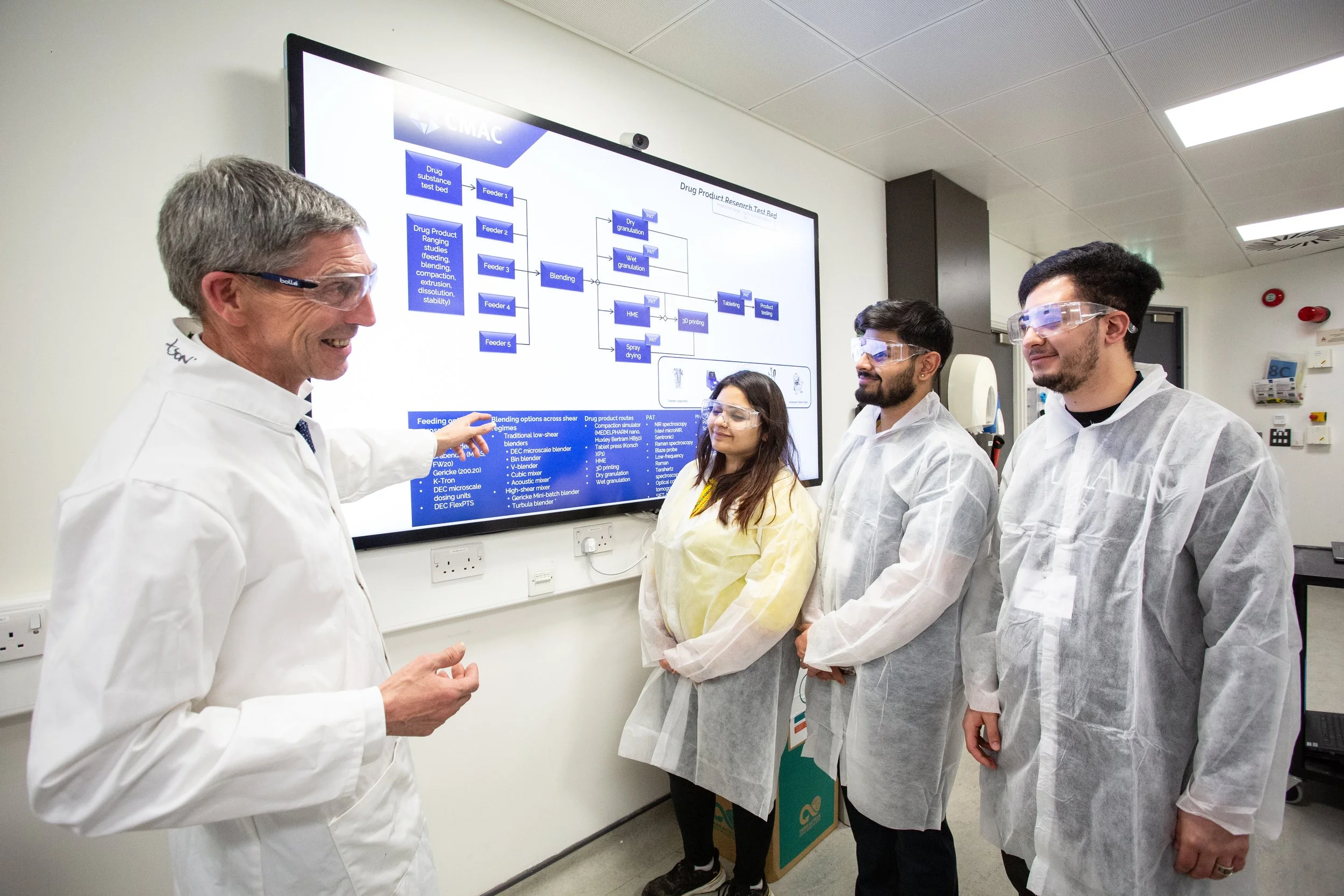
Model-based digitalisation for continuous manufacturing - a KTP case study
Partners: University of Sheffield, CMAC and Process Systems Enterprise (PSE, now Siemens)
Programme: Innovate UK Knowledge Transfer Partnership (KTP)
Challenge
Pharmaceutical manufacturers require robust, efficient ways to design and implement continuous manufacturing processes. However, applying advanced mechanistic modelling tools at scale, especially across both batch and continuous operations, remains complex and often inaccessible to non-expert users.
Approach
Through this KTP, the partners developed a systematic, model-based digitalisation framework underpinned by mechanistic modelling. The project combined academic expertise with industrial application to:
Build and validate mechanistic models for continuous pharmaceutical manufacturing
Create practical, industry-ready workflows for applying modelling tools in active ingredient manufacture
Enhance the functionality and usability of the gPROMS Formulated Products platform
Broaden accessibility for users ranging from plant operators to expert engineers
The models were implemented within gPROMS and validated using the University of Sheffield’s continuous manufacturing facilities, ensuring both technical robustness and real-world applicability.
Impact
The project delivered a step-change in the usability and capability of mechanistic modelling tools, enabling more efficient end-to-end process design and optimisation. By embedding advanced modelling into accessible workflows, it supports wider adoption of digitalisation across the pharmaceutical sector—accelerating the transition to continuous manufacturing and improving process understanding, control, and performance.
Get in touch
