

Digital CMC Regulatory Lifecycle framework
Overview
Our Digital CMC Regulatory Lifecycle (DCRL) framework helps innovators, manufacturers and regulators build confidence that digital tools are reliable, transparent, proportionate to risk, and suitable for regulatory or manufacturing use.
The framework supports the responsible adoption of digital and AI-enabled tools across pharmaceutical chemistry, manufacturing and controls (CMC), helping accelerate safe, sustainable and efficient medicines development while protecting product quality, patient safety and regulatory trust.
By providing a common language and practical workflow for industry, academia and regulators, the framework helps reduce uncertainty around evidence expectations, model credibility, documentation and lifecycle oversight.
What it supports
Both the DCRL framework and the DCRL workflow guide across:

The DCRL framework structure
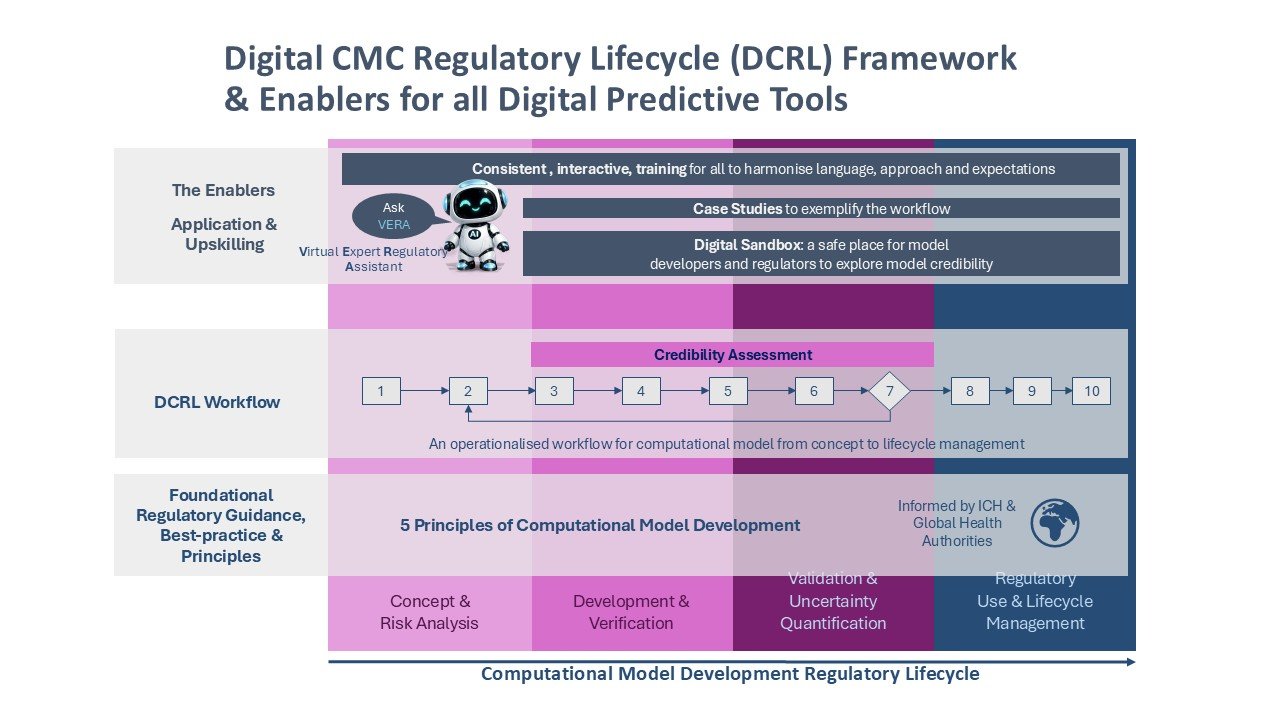
Built around three connected layers that support the development, assessment and regulatory implementation of digital predictive tools in CMC, the layers create a regulator-ready bridge between digital innovation and pharmaceutical quality assurance, supporting consistent development, assessment and implementation of digital tools in CMC.
-
The DCRL framework is supported by four enablers that facilitate practical adoption and shared understanding across stakeholders. These include 4 regulatory use cases to demonstrate real-world application, Virtual Expert for Regulatory Assistance (VERA), a collaborative Digital CMC Sandbox for static credibility assessment with an interactive element and evidence generation, and targeted, modular and interactive training platforms (e.g. SkillsFactory) to build capability.
Together, these enablers provide the consistent language, approach, templates, knowledge for regulators, industry and academia to translate principles into consistent, regulator-ready practice.
-
The workflow guides digital tools through the 4 phases of computational model lifecycles from early concept and risk analysis through development, validation, verification, uncertainty quantification, regulatory use and lifecycle management.
10 detailed stages help users define the question of interest, context of use, model type, model risk, data requirements, credibility evidence, regulatory documentation and post-deployment control.
-
The bottom layer anchors the framework in five core principles adapted for Digital CMC which are applicable to knowledge driven, data-driven (including AI and empirical models) and hybrid models:
Safety, security and robustness
Transparency and explainability
Fairness and avoidance of bias
Accountability and governance
Contestability, human oversight and redress
While not all the principles are applicable to all model types, by collating them and adapting them for a CMC context, the principles provide a valuable aide-memoir resource to help users consider all aspects and ensure credibility assessments are regulatory-aligned. These principles are aligned to collated global regulatory guidance, standards and scientific literature, including ICH guidance, FDA, EMA and MHRA expectations, ASME standards, and peer-reviewed best practice.
Explore the DCRL framework and workflow

An interactive version has been developed to help users explore the principles, considerations and evidence expectations relevant to computational models across their lifecycle. The framework also provides links to guidance, standards and supporting resources to support practical implementation.
This tool offers additional detail and references behind the core elements of the framework for computational model lifecycles in CMC. It supports regulatory-aligned model development and implementation by enabling users to explore:
Five principles for computational model development
Workflow stages
Four lifecycle phases of a computational model
How to use the framework
Select a workflow stage, lifecycle phase or principle to view a summary description and relevant reference materials.
To understand how the principles apply throughout the model lifecycle, select one of the five computational model development principles and explore each of the four lifecycle phases. This will show how and when the principle should be considered during model-development, implementation and ongoing management.
The referenced resources support regulatory-aligned model approaches to computational model development, deployment and lifecycle management.
Explore the framework
Use the interactive DCRL framework to identify the principles, evidence expectations and key considerations relevant to different computational models and stages of development.
Key concepts
The DCRL Framework is underpinned by the following core regulatory and scientific concepts that support the responsible development, assessment and implementation of digital tools in pharmaceutical CMC:

These concepts align with international guidance and emerging best practice, including expectations from ICH, EMA, FDA and MHRA.
Join our mailing list

Stay up to date with news and events from Digital CMC CERSI and the wider CMAC network — including webinars, workshops, and community updates.
Funding and support
Funded and supported by the MHRA and the Office for Life Sciences (OLS) managed by Innovate UK with delivery partner Medical Research Council (MRC) the as part of the “RS&IN Implementation Phase: Human Health CERSI” Innovate UK: Project no. 10139447